

News
Astronomers Discover Supermassive Black Hole
March 28, 2012 Nicola  |
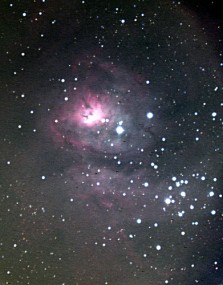
The supermassive blackhole is so far away that its light has taken an incredible 13 billion years to reach earth.
About two billion times the mass of our sun, it is part of a galaxy called J1120+0641 and is the most distant super massive black hole known to science.
Bram Venemans of the Max-Planck Institute for Astronomy in Heidelberg, Germany, enthusiastically told the BBC: “It’s an indication of just how dynamic the early Universe must have been.
“The glow of carbon tells us there are stars being formed, and the dust also tells us that - that there is lots of ultraviolet light [from bright new stars] heating the dust. But the amount of carbon we can derive means a lot of stars must have formed and produced this carbon.”
He and colleagues used the IRAM array of millimetre-wave telescopes in the French Alps to make their study of J1120+0641.
They observed the distant galaxy as it was just 740 million years after the Big Bang, when the abundance of chemical elements in the cosmos would have been dominated far more by hydrogen and helium than it is today.
Dr Venemans explained: “We found this accreting black hole and you see these metal lines, and that is not too surprising. This is quite a small region of space and you only need a couple of stars to go into the black hole to pollute its signal. But it’s the same across the galaxy.”
This means J1120+0641 is rapidly producing stars and cycling heavier and heavier elements. From observations made by Dr Venemans and his colleagues, they have calculated that J1120+0641 was forming those stars at a rate 100 times faster than seen in our Milky Way Galaxy today.
Although it is not as fast as some big galaxies, it is still impressive compared to other galaxies later in cosmic time.
By Kate Wilson
[Image courtesy of ringsofsaturnrock]

