

Features
Shale Shock: Is Fracking on the Increase?
March 28, 2012 Nicola  |
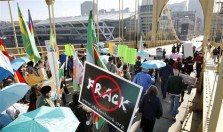
Fracking, a gas extraction technique first used in the 1990s, is highly controversial and due to expand across the UK.
One place where fracking could begin in the near future is Swansea, South Wales. According to a Facebook campaign by Fracked Swansea:
“[A] license [was] granted by the Coal Authority and held by the Clean Coal Company to drill into and set alight the 200m tonnes of coal which lies beneath the sea in Swansea Bay. This coal is un-minable and will be combusted in situ. This process releases carbon monoxide-heavy ‘syngas’ which is collected and burnt at the surface.”
Although a licence was granted to allow fracking to happen in Swansea, planning permission as yet has not been obtained. Campaigners are worried that the Clean Coal Company will go ahead with the procedure anyway. They say that this will cause unimaginable harm to the environment and the people living in the area.
Anti-fracking campaign group Frack Off told The Fresh Outlook: “The tidal wave of unconventional gas development that is hitting the British Isles is seriously bad news for everyone. Shale gas, coal-bed methane and underground coal gasification - the three types of gas which can require hydraulic fracturing (fracking) to get at the resource - come with a history of causing severe ground-water contamination.”
Fracking is the practise of drilling in to shale rock in order to obtain the methane gas contained within. The well used for fracking consists of a metal tube lined with alternate layers of metal and concrete. The tubes are drilled seven to eight thousand feet in to the rock, controlled explosions open up fractures within the rock and then highly-pressurised water and other chemicals are sent through the tube in order to shatter the rock and extract the gas.
There are shale rocks stretching under the Pennine basin from Blackpool to Scarborough, which are all potential sites for fracking companies. The extraction of natural gas using this method is already taking place in Lancashire and Blackpool, where it was blamed for causing earthquake-like tremors in these areas.
After the earthquakes, the government reviewed fracking. But the practise still continues and the fact that drilling sites are in such proximity to where people live makes people uneasy.
Local health authorities are meant to ensure that the fracking companies are obeying safety regulations. However, according to a report by the BBC’s Newsnight programme, Mike Hill, a technical advisor to Fydeborough Council claims that in Lancashire the health authorities had not visited a fracking site once during the last two years.
In one site near Lancashire, Preese Hill, a company called Quadrilla stopped drilling after the tremors. But their water tanks, which are now contaminated with radiation, are still stored at the site. The company does not have a permit to allow them to remove it.
According to Mr Hill, it’s when the concrete layer inside the tube becomes shattered that the risk of contamination increases.
Furthermore, online videos show residents in the United States being able to light their drinking water as a result of the fracking which took place in the nearby area. The flames were blamed on gas from the fracking process leaking in to the water system.
Chesapeak, the second-largest American fracking company, admitted to the BBC’s Newsnight that it had found gas leaks and as a result has changed its fracking procedure.
“In some cases it looks like as the cement was drying the high pressure shallow methane kept the cement from drying properly and would allow channelling on the outside of the casing which then can allow methane to move upwards to a shallower zone and move in to fresh water,” one worker from Chesapeak Energy told the BBC.
Frack Off, however; claim that flaming drinking water is only part of the story:
“A Duke University study recently showed that water wells tested which were within a mile of active fracking sites in Pennsylvania consistently had much higher concentrations of methane than those further away from those active fracking sites. Flaming tap water is not what people should be focusing on.
“Leaking methane has a far more sinister effect on our lives. A Cornell University Study recently concluded that because of ‘fugitive emissions’ (methane which escapes unintentionally) shale gas extraction caries a greater environmental footprint than coal.”
Two countries, France and Bulgaria, have banned fracking on health grounds. In Lower Saxony, Germany the practise has been linked to an increased risk of cancer throughout the region. In the town of Allerdorf, despite the small population, the rate of cancer is high. A third of residents have the disease.
In the UK, however, the benefits of fracking prove tempting. It has been calculated that there are 200 trillion cubic feet of natural gas which could supply the country with natural gas for years to come and be worth billions of pounds.
“We [the UK] are the test case for technology that has never been used in this way, on this scale and in a place where so many people live. We must allow ourselves, our communities and our water be destroyed by a handful of companies looking to make a swift buck,” the Frack Off spokesperson added.
By Louisa Guise
[Image courtesy of yourlawyer]

